Top IT Services Trends in 2026 | Indai Technologies
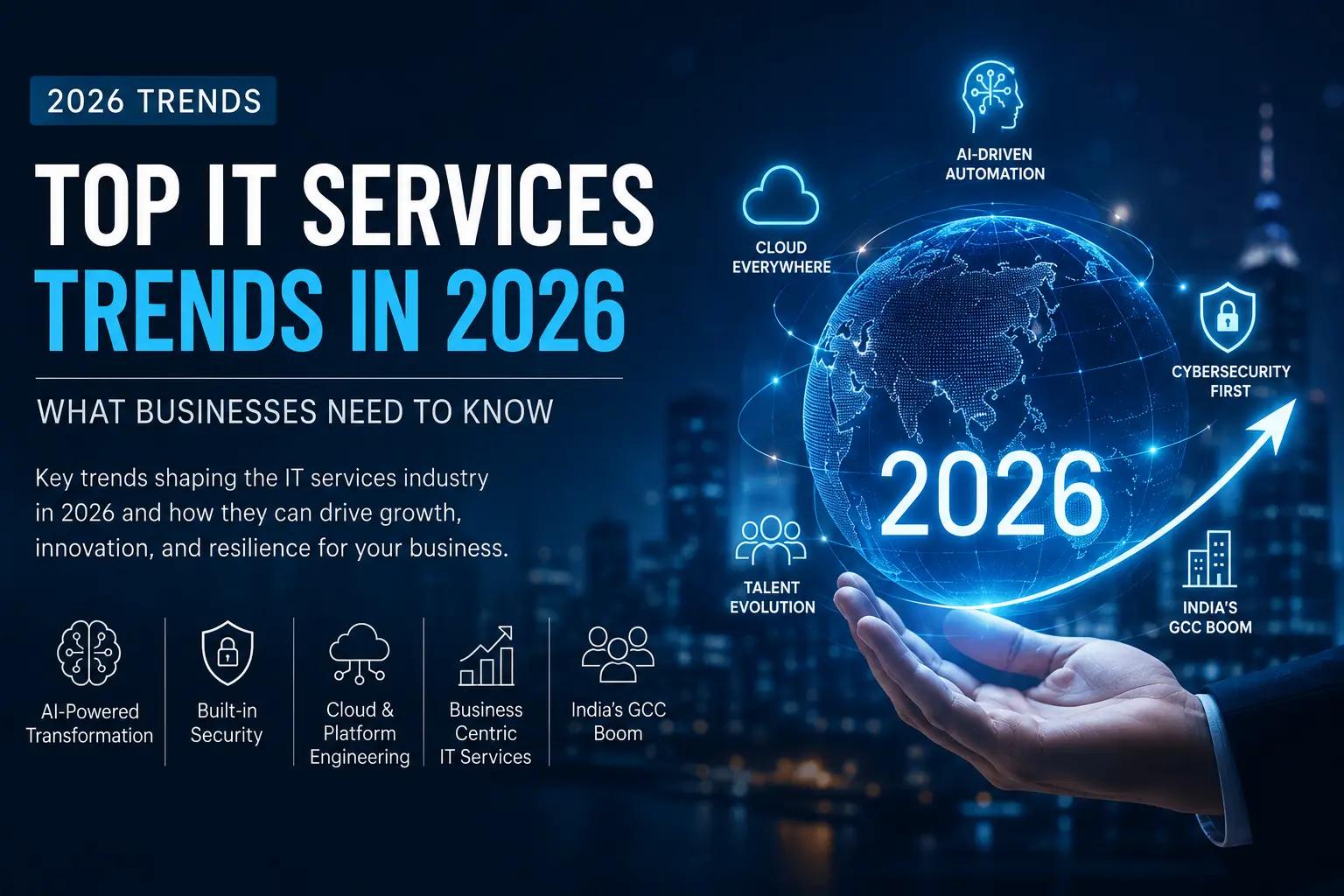
# Top IT Services Trends in 2026: What Businesses Need to Know
The IT services industry isn't just growing in 2026 — it's changing shape. Analysts now put the global IT services market at roughly $1.8 trillion this year, and in India alone, IT spending is expected to cross $176 billion, growing over 11% year-on-year. But the bigger story isn't the size of the market — it's how the work itself is being redefined by AI, tighter security demands, and a new generation of service delivery models.
For businesses evaluating an IT partner — or IT services companies trying to stay ahead — here are the five trends actually shaping 2026, and what they mean in practical terms.
## Why 2026 Is a Turning Point for IT Services
For the last two years, most conversations about AI in IT services were about pilots and proof-of-concepts. In 2026, that's shifted. AI tools are now embedded inside delivery teams rather than sitting alongside them, regulatory frameworks around AI use are maturing, and clients are asking sharper questions about value, not just capacity. Every trend below is a version of the same shift: IT services are becoming more automated, more product-like, and more accountable.
## 1. Agentic AI Moves From Experiment to Everyday Delivery
AI agents capable of writing, testing, and reasoning through code are now a standard part of software delivery rather than a novelty. Developer surveys show a large majority of engineers report feeling more productive with AI assistance, and the cost of running models at a given capability level has fallen sharply over the past couple of years — which is why adoption has accelerated so quickly.
In practice, this shows up as:
- AI-assisted coding, testing, and code review baked into everyday workflows
- AI-enabled service desks that can route tickets, detect root causes, and suggest fixes automatically
- Smaller delivery teams supplemented by AI tools rather than headcount growth
Importantly, industry analysts are consistent on one point: generative AI is changing *how* the work gets done, not eliminating the need for it. Clients still need human judgment on priorities, trade-offs, risk, and what "good" looks like — AI just changes the shape of the team delivering it.
## 2. IT Services Start Looking Like Products, Not Projects
The old model of scoping a custom project from scratch for every client is giving way to something more repeatable. IT services firms are increasingly packaging their delivery as reusable building blocks, frameworks, and playbooks — an approach often called platform engineering — so that a proven pattern for, say, cloud migration or data modernization can be adapted quickly rather than rebuilt each time.
Alongside this, industry-specific cloud platforms (purpose-built for sectors like healthcare, financial services, or manufacturing) are becoming the default starting point for many engagements, instead of generic infrastructure.
## 3. Cybersecurity and Compliance Get Built In, Not Bolted On
As AI tools touch more of the software lifecycle, regulators are paying closer attention — and that's pushing security and compliance earlier into the process. "Security by design" is no longer a differentiator; it's baseline. IT services companies are being asked to demonstrate how they handle data privacy, model governance, and audit-readiness as part of the delivery itself, not as a separate add-on engagement.
This is showing up most visibly in regulated sectors — finance, healthcare, and energy — where cyber threat investment continues to climb alongside AI adoption.
## 4. Managed Services Evolve Into Strategic Technology Partners
Managed service providers used to be judged mainly on uptime. In 2026, the role has expanded. Businesses are managing relationships across cloud vendors, cybersecurity providers, and AI platforms simultaneously, and they're leaning on managed services partners to help evaluate that ecosystem — not just keep the lights on.
That means the best IT partners now offer:
- Proactive threat detection and real-time monitoring, not just reactive support
- Help benchmarking and choosing between competing technology vendors
- Data-informed recommendations, rather than one-size-fits-all packages
## 5. India Becomes the Engine Room of Global IT Services
India's role in global IT delivery is accelerating, not just holding steady. A few data points worth knowing:
- India's IT-BPM sector is on track to cross $315 billion in FY26, up roughly 6% year-on-year
- Global Capability Centres (GCCs) in India are projected to grow from around 1,700 today to 2,100–2,200 by 2030
- AI-specific services are still a small share of total IT revenue (around 3–4%) but are growing the fastest, with analysts estimating an incremental AI-led addressable market of $300–400 billion by 2030
- Demand for AI-skilled talent is expected to cross a million roles in India, even as the country faces a meaningful AI skills gap — making upskilling a business priority, not just an HR initiative
For businesses sourcing IT services — whether locally or globally — this means India-based partners are increasingly where AI-native delivery capability, cost efficiency, and scale intersect.
## What These Trends Mean for Choosing an IT Partner
If you're evaluating an IT services provider in 2026, these trends translate into a few practical questions worth asking:
- Do they build with reusable frameworks, or are you paying for everything to be built from zero?
- Is security designed in from day one, with clear answers on data handling and AI governance?
- Can they show real AI-augmented delivery — faster turnaround, not just AI as a buzzword?
- Do they operate as a long-term technology partner, helping you navigate vendor and platform choices, rather than a one-off vendor?
## How Indai Technologies Can Help
At Indai Technologies, we help businesses modernize their applications, adopt AI-driven delivery, and build security into every engagement from day one." Replace this placeholder with your actual service lines and a link to your Services or Contact page.
## FAQs
What's the biggest IT services trend for 2026?
The shift of agentic AI from pilot projects into everyday delivery — AI is now embedded directly into coding, testing, and service management workflows.
Will AI replace IT services companies?
No. Industry analysis consistently shows AI changes how services are delivered, not whether they're needed — human judgment on priorities, risk, and trade-offs remains central.
Why is India significant to global IT services in 2026?
India combines large-scale delivery capability, a fast-growing Global Capability Centre ecosystem, and a cost advantage, making it a key hub for both traditional and AI-led IT services.
How should a business prepare for these shifts?
Start by auditing AI readiness, reviewing how security and compliance are built into current workflows, and evaluating whether existing IT partners operate as strategic advisors or just vendors.
---
*Sources referenced: Gartner, Nasscom, KPMG, Grand View Research, and industry analysis from ICICI Direct and Wisemonk on India's IT-BPM sector (2026).*